Hey there! I’m in the business of supplying polyurethane screen panels, and I often get asked, "What is the coefficient of friction of a polyurethane screen panel?" Well, let’s dive into this topic and break it down. Polyurethane Screen Panel
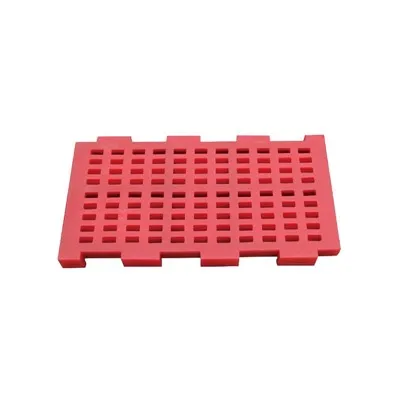
First off, what’s the coefficient of friction anyway? It’s a measure that tells us how much two surfaces resist sliding against each other. You can think of it as a number that shows how "sticky" or "slippery" a surface is when it comes in contact with another. There are two main types: static and kinetic. The static coefficient of friction is relevant when the surfaces are at rest and you’re trying to get them to start moving. The kinetic one comes into play when the surfaces are already in motion.
Now, for polyurethane screen panels. Polyurethane is a pretty amazing material. It’s tough, durable, and has some unique properties that affect its coefficient of friction. The coefficient of friction of a polyurethane screen panel can vary depending on a few factors.
One big factor is the surface finish of the panel. If the surface is smooth, it’ll generally have a lower coefficient of friction. That means things will slide over it more easily. On the other hand, if the surface has some texture or roughness, the coefficient of friction will go up. This is useful in some applications where you need to grip the material being screened. For example, in a mining operation where you’re screening rocks, a slightly rough polyurethane screen panel might be better at holding the rocks in place during the screening process, reducing the chances of them bouncing off too easily.
The type of polyurethane used also matters. Different formulations of polyurethane have different chemical and physical properties. Some polyurethanes are designed to be more lubricious, which will result in a lower coefficient of friction. Others are made to be more abrasive – resistant and might have a higher coefficient of friction as a result.
The environment in which the screen panel operates can also have an impact. If the panel is used in a wet environment, the presence of water can act as a lubricant and reduce the coefficient of friction. In a dusty environment, the dust particles can get between the surfaces and change the friction characteristics. High – temperature environments can cause the polyurethane to soften slightly, which might also affect the coefficient of friction.
So, what’s a typical range for the coefficient of friction of a polyurethane screen panel? Well, it can be anywhere from around 0.2 to 0.8. But remember, this is a very rough estimate. The actual value can be higher or lower depending on the factors I just mentioned.
Let’s talk about why the coefficient of friction is important for polyurethane screen panels. In screening applications, the right coefficient of friction can improve the efficiency of the screening process. If the coefficient is too low, the material being screened might not stay on the panel long enough to get properly sorted. If it’s too high, the material might get stuck on the panel, causing blockages and reducing the throughput.
For example, in a food processing plant where you’re screening grains, you want a coefficient of friction that allows the grains to move smoothly across the panel without getting stuck. But you also don’t want them to slide off too quickly before they’ve been properly screened.
In a recycling facility, where you’re screening different types of plastics and metals, the coefficient of friction affects how well the different materials are separated. A well – chosen coefficient of friction can help ensure that the heavier metals stay on the panel longer while the lighter plastics slide off more easily.
Now, as a supplier of polyurethane screen panels, we’ve got a lot of experience with different applications and different coefficient – of – friction requirements. We can work with you to figure out the best type of panel for your specific needs. Whether you need a panel with a low coefficient of friction for a high – speed screening process or a higher one for better grip, we’ve got you covered.
We use state – of – the – art testing equipment to measure the coefficient of friction of our panels. This helps us ensure that we’re providing a consistent product that meets our customers’ expectations. And we’re always looking for ways to improve. We do research and development to come up with new formulations of polyurethane that can offer the perfect coefficient of friction for different industries.
If you’re in the market for polyurethane screen panels, don’t just go for the cheapest option. Consider the coefficient of friction and how it will affect your screening process. A panel with the right coefficient of friction can save you time and money in the long run by improving efficiency and reducing maintenance.
We also offer custom – made polyurethane screen panels. If you have a unique application with specific coefficient – of – friction requirements, we can work with you to design and manufacture a panel that’s just right for you. Our team of experts is always available to answer your questions and provide technical support.
So, if you’re interested in learning more about our polyurethane screen panels and how the coefficient of friction can impact your business, don’t hesitate to get in touch. We’d love to have a chat with you about your needs and see how we can help you improve your screening process. Reach out to start a conversation about how we can supply you with the best polyurethane screen panels for your operation.
Polyurethane Screen Panel References:
- "Polyurethane Materials and Their Applications" – A comprehensive textbook on the properties and uses of polyurethane.
- Industry reports on screening technology and the performance of different screen panel materials.
- Research papers on the frictional properties of polymers and their impact on industrial processes.
Yangzhou Yaye Wire Mesh Manufacturing Co., Ltd.
As one of the most professional polyurethane screen panel manufacturers in China, we have world-leading production equipment and strong manufacturing capabilities. Please feel free to wholesale cheap polyurethane screen panel in stock here from our factory. Also, free sample is available.
Address: No. 1 Jiangjia Road, High-tech Industrial Park, Jiangdu District, Yangzhou City, Jiangsu Province
E-mail: 13952515577@163.com
WebSite: https://www.yayescreen.com/
