Hey there! As a supplier of transformer radiators, I’ve been in the thick of the transformer world for quite some time. One question that comes up a lot is how the power rating of a transformer affects the choice of a transformer radiator. Let’s dig into this topic. Transformer Radiator

First off, what’s power rating anyway? In simple terms, the power rating of a transformer tells you how much electrical power it can handle and transfer from one circuit to another. It’s usually measured in volt – amperes (VA), kilovolt – amperes (kVA), or megavolt – amperes (MVA). The higher the power rating, the more power the transformer can deal with.
Now, why does this matter for choosing a radiator? Well, transformers generate heat when they’re in operation. The amount of heat produced is directly related to the power rating. You see, when a transformer is working to transfer electrical power, there are losses in the form of heat. These losses come from two main sources: copper losses and iron losses.
Copper losses happen due to the resistance of the copper windings in the transformer. The higher the current flowing through these windings (which is often related to a higher power rating), the more heat is generated according to the formula (P = I^{2}R) (where (P) is power loss, (I) is current, and (R) is resistance). Iron losses, on the other hand, are caused by the alternating magnetic field in the transformer’s core and are also affected by the power rating.
So, if we’ve got a transformer with a low power rating, say a few kVA, the amount of heat it generates is relatively small. For these low – power transformers, a simple and less – complex radiator might be sufficient. A basic fin – type radiator could do the job. These fin – type radiators have a series of fins that increase the surface area for heat transfer. The heat from the transformer is transferred to the fins, and then the fins dissipate the heat to the surrounding air.
Let’s take an example of a small transformer used in a local power distribution unit for a residential area. It might have a power rating of around 10 – 50 kVA. For this kind of transformer, a radiator with a relatively small number of fins and a compact design can work well. It doesn’t need a huge radiator because the heat load is not that high.
But when we move on to medium – power transformers, with ratings in the range of hundreds of kVA to a few MVA, things get a bit more serious. These transformers generate a significant amount of heat, and a more efficient cooling solution is required. We might start looking at radiator designs with forced – air cooling or even oil – cooled radiators.
Forced – air cooling involves using fans to blow air over the radiator fins. This speeds up the heat transfer process because the moving air carries away the heat more quickly than still air. For medium – power transformers, this can be a great option. The fans can be controlled based on the temperature of the transformer, so they only run when needed, saving energy.
Oil – cooled radiators are also popular for medium – power transformers. In these systems, the transformer is immersed in oil, which acts as both an insulator and a coolant. The heated oil circulates through the radiator, where it transfers its heat to the radiator fins and then to the air. The oil – cooling system can handle a larger heat load compared to air – cooled systems alone.
Now, when it comes to high – power transformers with ratings in the tens or hundreds of MVA, we’re talking about some serious heat generation. These transformers are often used in large power plants or high – voltage transmission substations. For these beasts, we need top – notch radiator solutions.
One option is a combination of forced – air and forced – oil cooling. In this setup, not only are there fans blowing air over the radiator fins, but there are also pumps that circulate the oil more quickly through the radiator. This double – whammy approach ensures that even the massive amount of heat generated by high – power transformers can be effectively dissipated.
Another important factor related to the power rating and radiator choice is the ambient temperature. If the transformer is located in a hot climate, a radiator that can handle a higher heat load is needed, regardless of the power rating. For example, a medium – power transformer in a desert area might require a radiator with a similar capacity to a high – power transformer in a cooler climate.
The size of the radiator is also affected by the power rating. Higher – power transformers generally need larger radiators to provide enough surface area for heat transfer. However, we also need to consider the available space at the installation site. Sometimes, we have to get creative with the radiator design to fit within the space constraints while still providing sufficient cooling.
In addition to the design and cooling method, the material of the radiator is crucial. For high – power applications, materials with high thermal conductivity like aluminum or copper alloys are often used. These materials can transfer heat more efficiently from the transformer to the radiator and then to the surrounding environment.
Let’s talk about maintenance as well. High – power transformer radiators, especially those with complex cooling systems like forced – air and forced – oil, require more regular maintenance. We need to check the fans, pumps, and oil levels frequently to make sure everything is working properly. For low – power transformers with simple fin – type radiators, the maintenance is usually much less intensive.
As a transformer radiator supplier, I know that choosing the right radiator for a transformer is a balance between the power rating, the cooling requirements, the ambient conditions, and the installation space. We work closely with our customers to understand their specific needs and recommend the most suitable radiator solutions.
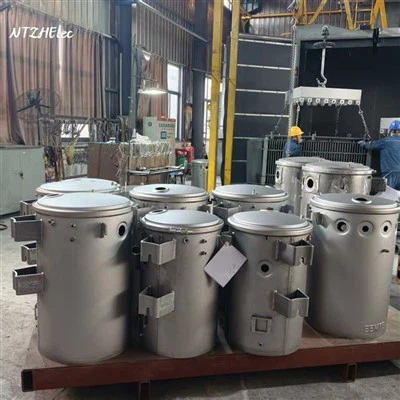
If you’re in the market for a transformer radiator, whether it’s for a small – scale project or a large – industrial application, we’re here to help. We’ve got a wide range of radiators to choose from, and our team of experts can guide you through the selection process. Don’t hesitate to reach out to us to start a discussion about your requirements.
Transformer Radiator References:
- Electrical Power Systems by J. Arrillaga, N. R. Watson
- Transformer Engineering: Design, Technology, and Diagnostics by George Anders
Nantong Zhihe Electric Co., Ltd.
As one of the most professional transformer radiator manufacturers and suppliers in China, we’re featured by quality products and low price. Please rest assured to wholesale cheap transformer radiator made in China here from our factory. Customized orders are welcome.
Address: NO.202 Jianghai West Road, Hai’an Town, Hai’an City, Jiangsu Province
E-mail: colt.ntzh@gmail.com
WebSite: https://www.ntzhelectric.com/
